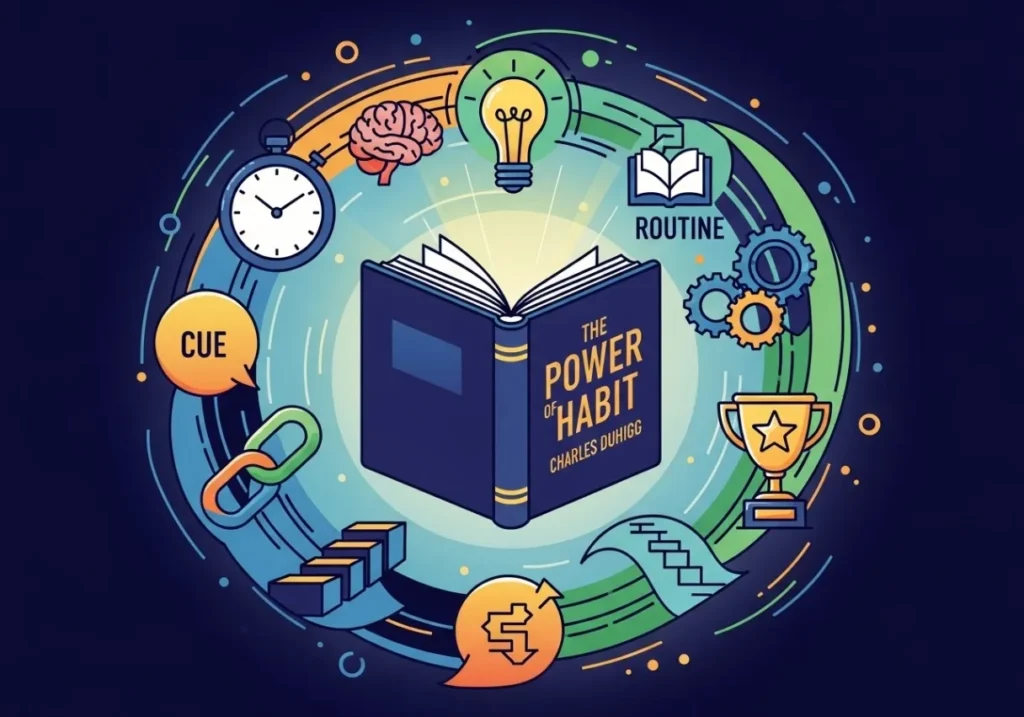
How to Hack Your Life’s Source Code
Imagine a rat in a maze. The gate opens (click). The rat runs. It finds the chocolate. It eats.
At first, the rat’s brain is working hard, analyzing every turn. But after 100 times? The brain activity actually shuts down. The rat is running on autopilot. It doesn’t need to think. It just acts.
You are that rat.
According to Duke University researchers, 40% of the actions you take every day are not decisions—they are habits. You don’t decide to brush your teeth, check Instagram, or drive to work. You just do it.
In his massive bestseller The Power of Habit, Charles Duhigg explains that our lives are just a collection of these loops. If you want to change your life—lose weight, build a business, or stop doom-scrolling—you can’t just “try harder.” You have to hack the code.
Part 1: The Habit Loop
Duhigg discovered that every habit in history—from smoking to brushing teeth—follows the exact same three-step structure.
1. The Cue 🔔
The trigger that tells your brain to go into automatic mode. It could be a time of day, a location, or an emotion.
Example: Your phone buzzes.
2. The Routine 🏃
The behavior itself. This can be physical (eating a donut), mental (feeling anxious), or emotional.
Example: You pick up the phone and check Instagram.
3. The Reward 🏆
The reason your brain likes this habit. It helps your brain figure out if this loop is worth remembering.
Example: A hit of dopamine / distraction from boredom.
Part 2: The Golden Rule of Change
Here is the hard truth: You cannot extinguish a bad habit.
Once the neural pathways are formed, they are there forever. That is why alcoholics can relapse after 20 years. The loop is still waiting.
So, how do we change?
You must keep the old Cue, and deliver the old Reward, but insert a new Routine.
Every day at 3 PM (Cue), Charles went to the cafeteria and ate a cookie (Routine) and chatted with friends (Reward: Socializing).
To change, he kept the Cue (3 PM) and the Reward (Socializing), but changed the Routine: He walked to a friend’s desk to chat without the cookie.
Part 3: The Craving (The Fuel)
The loop isn’t enough. For a habit to stick, you need a Craving.
The Pepsodent Story
In the early 1900s, no one brushed their teeth. Claude Hopkins, an ad man, sold Pepsodent toothpaste by creating a craving.
He added citric acid and mint oil to the paste. It created a cool, tingling sensation.
That “tingle” didn’t clean teeth. But it created a craving. If people brushed and didn’t feel the tingle, they felt their mouth wasn’t clean. The tingle powered the loop.
The 2025 Equivalent: Notification Dots
Why do you check apps with red notification badges? Because you crave the feeling of “Inbox Zero” or the validation of a “Like.”
The red dot creates a visual itch (craving) that you must scratch (routine) to get relief (reward).
Part 4: Keystone Habits (The Domino Effect)
You don’t have to change 50 things to fix your life. You usually just need to fix one Keystone Habit.
Keystone habits are small changes that start a chain reaction.
Example 1: Exercise
People who start exercising once a week often start eating better, smoking less, and using their credit cards less. The discipline spills over.
Example 2: Making Your Bed
It seems small, but making your bed every morning correlates with better productivity and budgeting skills. It starts the day with a “win.”
Part 5: Willpower is a Muscle
Duhigg explains that willpower isn’t a skill you either have or don’t have. It is a muscle that gets tired.
The Radish Experiment: Researchers put students in a room with warm cookies and a bowl of radishes. One group was allowed to eat the cookies. The other group was forced to eat the radishes and ignore the cookies.
Then, they tried to solve an impossible puzzle. The “Cookie Eaters” worked for 20 minutes. The “Radish Eaters” gave up in 8 minutes.
Why? The Radish Eaters had depleted their willpower muscle resisting the cookies. They had nothing left for the puzzle.
Lesson: Do your hardest tasks in the morning when your willpower tank is full.
Part 6: Corporate Habits (Starbucks & Target)
☕ Starbucks: Institutional Willpower
Starbucks trains employees to handle angry customers by turning it into a habit loop, so they don’t use up willpower.
The LATTE Method:
- Listen
- Acknowledge
- Take Action
- Thank
- Explain
By making this a routine, baristas stay calm on autopilot.
🎯 Target: The Prediction Habit
Target analyzes shopping data. They found that women who suddenly buy unscented lotion and mineral supplements are likely in their second trimester of pregnancy.
Target would then send them coupons for diapers before the baby was born. They capitalized on a major life change (having a baby) to become the customer’s new habit.
Part 7: The Power of Belief
In studying Alcoholics Anonymous (AA), researchers found that habit replacement works well, but in high-stress moments, people relapse.
What keeps them sober? Belief.
Specifically, the belief that change is possible, usually fostered within a group. You don’t need to believe in God, but you must believe in the possibility of a better future. Community (finding your tribe) creates this belief.
The 4-Step Framework
If you want to change a habit in 2025, do not guess. Follow the algorithm defined in the book.
Identify the Routine
What is the bad behavior? (e.g., Eating chocolate at 3 PM).
Experiment with Rewards
Are you hungry? Or are you bored? Try taking a walk instead. If the urge is gone, you were just bored.
Isolate the Cue
When the urge hits, write down: Time, Place, Emotion, People, Action immediately prior.
Have a Plan
Write it down: “When [CUE] happens, I will do [ROUTINE] to get [REWARD].”
“Change might not be fast and it isn’t always easy. But with time and effort, almost any habit can be reshaped.”
Conclusion: You Have the Power
The most important takeaway from the book is simply knowing that habits are malleable. You are not stuck with your current programming.
Your Next Steps:
- 🔍 Audit your day: Find the loops running on autopilot.
- 🔑 Pick one Keystone Habit: Start making your bed or walking 10 mins a day.
- 📝 Write the Plan: Use the “When [Cue], I will [Routine]” formula.
Now, go create a new loop. (Cue: Finished reading blog post. Routine: Share with a friend. Reward: Feeling smart.)

I don’t think the title of your article matches the content lol. Just kidding, mainly because I had some doubts after reading the article.