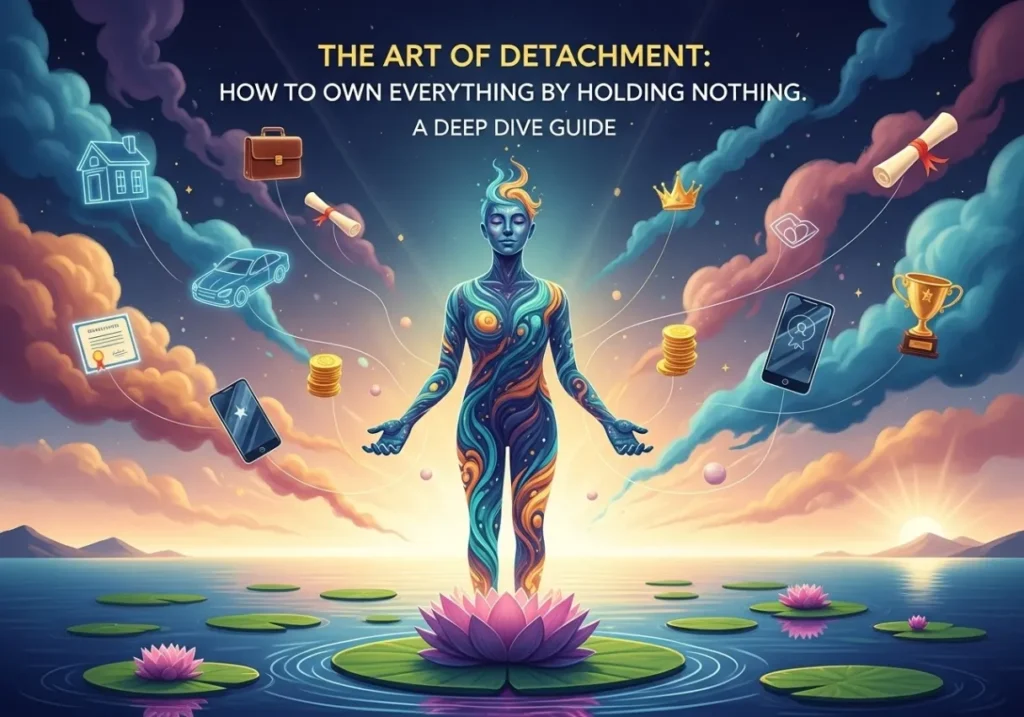
The Art of Detachment
To hold on is to suffer. To let go is to be free.
We are taught to chase. Chase the career, chase the partner, chase the outcome. We believe that if we grip these things tightly enough, we will be safe. But the paradox of life is simple: The tighter you squeeze, the more slips through your fingers.
The Art of Detachment is not about becoming a cold, unfeeling robot. It is not about indifference. It is about Liberation. It is the ability to walk through fire without getting burned.
In this Ultimate 2025 Guide, we will explore the delicate balance of caring deeply while remaining attached to nothing.
Part 1: The Myth of Control
Anxiety is nothing more than the gap between how things are and how you think they should be.
The Sand Analogy
Imagine holding a handful of dry sand. If you hold your hand open and flat, the sand stays. You possess it fully.
But the moment you squeeze your fist to “secure” the sand, it trickles out. The tighter you squeeze, the more you lose. Attachment is the squeeze.
The Rope Burn
Imagine you are holding a rope that is being pulled by a wild horse. The rope burns your hands. It drags you through the mud.
You scream, “This hurts!” But you refuse to let go. Detachment is simply opening your hand. The horse runs, but you are no longer dragged.
Part 2: Detachment is NOT Indifference
This is the biggest misunderstanding. People think detachment means “I don’t care.”
Indifference says: “It doesn’t matter what happens, so I won’t try.” (This is laziness/depression).
Detachment says: “I will try my absolute hardest, but I am at peace with whatever the result is.”
Real Life Example: The Job Interview
Attached: “I NEED this job. If I don’t get it, I am a failure.” (Result: Nervous, desperate energy).
Detached: “I prefer to get this job. I will prepare perfectly. But if I don’t get it, I know something else is coming.” (Result: Confident, magnetic energy).
Part 3: The 3 Laws of Flow
To master the art of detachment, you must align yourself with the universe’s natural rhythm. You must stop swimming upstream.
1. Allow
Let things be what they are. Stop projecting your fantasy onto reality. If it is raining, let it rain. Do not waste energy wishing for sun.
2. Accept
Acceptance is not resignation. It is clarity. Once you accept the situation (“I have lost my money”), only then can you take effective action to fix it.
3. Release
Release the need for a specific outcome. Trust that the universe/life/god often has a plan better than the one you scribbled on a napkin.
Part 4: Love Without Possession
The most painful attachments are to people. We confuse “Love” with “Need.”
The Clinging Trap
When you cling to a partner, you suffocate the relationship. You check their phone. You need constant reassurance. You are terrified of loss.
This fear actually creates the loss. It pushes them away.
The Open Door Policy
True love says: “I love you, and I want you to stay. But the door is open. If you choose to leave, I will be hurt, but I will be okay.”
This creates a magnetic confidence. People stay where they feel free.
Part 5: Goal Setting with Ease
How do you achieve big goals if you are detached? You use the Archer’s Mindset.
The Archer focuses intently on the bow, the stance, the breath, and the aim. These are in his control.
Once the arrow leaves the string, he relaxes. He does not scream at the wind. He does not run after the arrow trying to push it. He knows he did his part.
2025 Strategy: The “Preference” Shift
Stop saying “I need.” Start saying “I prefer.”
“I need to make $100k” creates stress. “I prefer to make $100k, and I will work for it” creates drive without the anxiety.
Part 6: The “Observer” Technique
How do you practice detachment in the heat of the moment? You become the Watcher.
Imagine you are sitting in a movie theater. The screen is your mind. Thoughts and emotions are the movie.
- Attached: You jump into the screen. You fight the bad guys. You cry with the hero. You are lost in the drama.
- Detached: You sit in the seat eating popcorn. You say, “Wow, that is a scary thought,” or “Look, there is a wave of anger.”
You are not the movie. You are the screen.
Conclusion: The Ultimate Freedom
Detachment is the ultimate superpower. It makes you unbreakable.
When you need nothing, you attract everything. When you are willing to lose, you win. When you let go, you finally have your hands free to receive.
Your Mantra:
“I own nothing. I am merely a guest in this universe. I enjoy, I experience, and when the time comes, I let go.”
Breathe out. Release. Be free.
Thank you for your sharing. I am worried that I lack creative ideas. It is your article that makes me full of hope. Thank you. But, I have a question, can you help me?
Thanks for sharing. I read many of your blog posts, cool, your blog is very good.