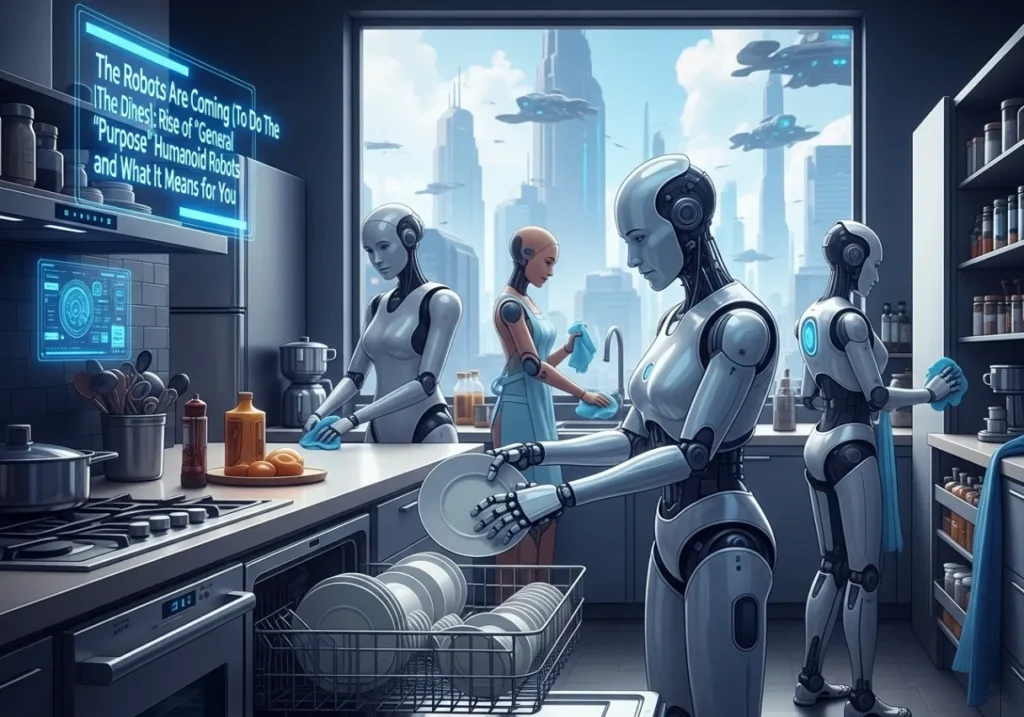
The Robots Are Coming (To Do The Dishes)
Science Fiction is becoming Science Fact.
For decades, robots were stupid. They could do one thing perfectly (like weld a car door), but if you moved the door by one inch, the robot would fail. They were “Single Purpose” machines.
But in 2024 and 2025, everything changed. We are witnessing the birth of the General Purpose Humanoid.
These aren’t just machines; they are artificial bodies powered by AI brains. They can walk, talk, fold laundry, make coffee, and work in factories alongside humans. Companies like Tesla, Figure, and Boston Dynamics are racing to put a robot in every home.
In this Ultimate Deep Dive, we will explore the tech, the top contenders, and the future of human labor.
Part 1: The “General Purpose” Shift
Why is everyone building human-shaped robots suddenly?
The World is Built for Humans
We could build robots with wheels or tracks. But stairs exist. Door handles exist. Shelves exist. Our entire world is designed for a bipedal (two-legged) creature with hands.
If you want a robot to be useful everywhere, it needs to be shaped like a human. It needs to fit in our world, not the other way around.
The AI Breakthrough
Previously, coding a robot to walk was impossibly hard. Now, we use Reinforcement Learning.
The robot learns to walk like a baby learns. It tries, falls, adjusts, and tries again—millions of times in a virtual simulation before it ever takes a step in the real world.
Part 2: The Top Contenders
Who is winning the race to build the “iPhone of Robots”?
Tesla Optimus
The Mass Producer. Elon Musk wants to make millions of these. It uses the same AI brain as Tesla’s Self-Driving Cars.
Status: Folding shirts in lab.
Figure 01
The Smartest. Backed by OpenAI. It can speak, reason, and hand you an apple if you ask for food. It “thinks” before it acts.
Status: Making coffee.
Atlas (New Electric)
The Athlete. Boston Dynamics retired their hydraulic robot for a sleek electric one. It moves with superhuman flexibility.
Status: Doing parkour.
Part 3: The Brain (Vision Language Models)
The body is engineering. The brain is AI.
Modern robots use VLM (Vision-Language Models). This means they can “see” the world and understand it using language.
2. VLM Analysis: “I see dirty plates. The user asked me to clean.”
3. Action Planner: “Pick up plate -> Move to sink -> Turn on water.”
4. Execution: *Robot arm moves.*
This allows them to understand vague commands like “Clean up this mess” without needing special code for every single object.
Part 4: Anatomy of a Bot
Actuators (The Muscles)
Old robots used hydraulics (oil pressure). They were loud and leaked.
New robots use Electric Actuators. These are powerful electric motors that act like joints. They are silent, precise, and super strong.
The Hands (The Difficulty)
The human hand is an engineering miracle. Replicating it is the hardest part of robotics.
Most bots currently have 5 fingers with tactile sensors so they can feel if an egg is about to break or if a tool is slipping.
Part 5: The Economics of Labor
Why are billions of dollars being poured into this? Demographics.
Populations are shrinking in developed nations. There aren’t enough people to work in factories, warehouses, or nursing homes. Robots are the proposed solution to the labor shortage.
If a robot costs $20,000 and works for 5 years without sleep, the cost of labor drops to nearly zero. This changes the global economy fundamentally.
Part 6: Will They Replace Us?
The million-dollar question.
Click to Reveal the Truth
Short Term: No. They will work in “structured environments” like factories doing dangerous or boring jobs.
Long Term: Yes and No. They will replace physical labor. But this might lead to an age of abundance where goods are cheap and humans focus on creative or interpersonal work.
Conclusion: The Sci-Fi Era is Here
We are living through a historical pivot point. Just as the car replaced the horse, the humanoid will replace the manual laborer.
It sounds scary, but it is also exciting. Imagine a world where dangerous jobs—mining, firefighting, toxic waste cleanup—are done by machines that can be repaired, saving human lives.
Key Takeaways:
- 🤖 General Purpose: One robot, infinite tasks.
- 🧠 Powered by AI: Vision Models make them smart.
- ⚡ Coming Soon: Expect them in factories by 2026.
The future isn’t knocking. It just opened the door.