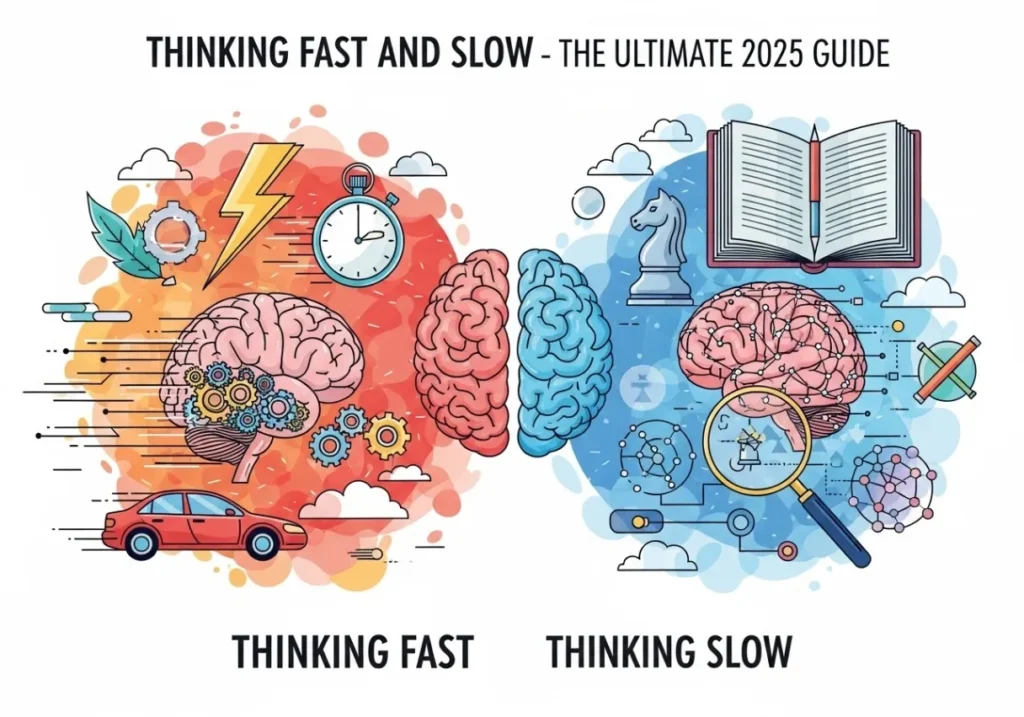
Why Your Brain is a Terrible Roommate
Imagine you bought the most expensive, high-tech supercomputer on Earth. It costs millions of dollars. It consumes 20% of your body’s energy. It is capable of sending rockets to Mars and composing symphonies.
You take it home, turn it on, and realize something terrifying: It has a mind of its own.
Sometimes, it calculates complex math instantly. Other times, it refuses to work because it’s “tired.” This computer is your brain.
Daniel Kahneman won the Nobel Prize for his book Thinking, Fast and Slow. It proves we are not logical robots. But the book is dense. This is your Ultimate 2025 Guide, broken down into digestible pieces.
Part 1: The Duel Inside Your Head
Kahneman’s core discovery is that the brain isn’t one single thing. It’s a partnership between two very different characters.
⚡ System 1: The Sprinter
The Autopilot
System 1 is fast, automatic, emotional, and requires zero effort. It runs 95% of your life.
- Turning to a sudden sound.
- Completing “Bread and…”
- Driving on an empty road.
🐢 System 2: The Hiker
The Pilot
System 2 is slow, logical, calculating, and lazy. It takes energy to activate. It thinks it’s in charge, but it’s usually sleeping.
- Parking in a narrow space.
- Comparing two smartphones.
- Checking logical arguments.
🧠 Brain Test: The Lazy Controller
Why do we make mistakes? Because System 2 is lazy. Try this riddle:
The bat costs $1.00 more than the ball.
How much does the ball cost?
👇 Click to reveal the truth
Did you say 10 cents? ❌ Wrong.
If the ball is 10c, and the bat is $1.00 more ($1.10), total is $1.20.
Correct Answer: 5 cents. (Ball = 0.05, Bat = 1.05).
Part 2: Heuristics & Biases
A “Heuristic” is a mental shortcut. Because System 2 is lazy, the brain uses shortcuts to make sense of the world. Often, these lead to errors.
Part 3: Priming (The Zombie Effect)
The “Florida Effect”: Students who read words associated with “old age” actually walked slower leaving the room. The mind primes the body.
📱 2025 Application: The Doom Scroll
When you scroll social media seeing perfect lives, you are being primed. Your System 1 soaks in “inadequacy.” When you put the phone down, you feel bad without knowing why.
Part 4: WYSIATI
What You See Is All There Is.
System 1 loves a good story, not a complete one. It constructs the best story out of available info and ignores what is missing. This leads to Overconfidence.
Example: The Halo Effect
If a CEO looks confident and handsome, System 1 assumes he is competent and his business is solid. We ignore missing data (financials, ethics) because we can’t “see” them.
Part 5: Anchoring (The Pricing Trick)
You see a bag for $5,000. “Insane!” Then you see one for $1,200. Suddenly, $1,200 looks cheap. The first number was an Anchor.
2025 Example: SaaS Pricing
Enterprise Plan: $499/mo (Anchor). Pro Plan: $99/mo (Target). Basic: $19/mo. The Enterprise plan exists only to make Pro look smart.
Part 6: The Availability Heuristic
System 1 estimates probability based on how easy it is to recall examples. We fear plane crashes (vivid images) but not car crashes (boring stats), even though cars are deadlier.
The Fix:
Whenever you fear a rare event (terrorism, AI apocalypse), look at the Base Rate (statistics), not the news headline.
Part 7: Regression to the Mean
Performance is Skill + Luck. If you have an amazing day (good luck), your next day will likely be worse (average luck). Don’t be arrogant after success or depressed after failure. It is just statistics.
Part 8: Prospect Theory (Money)
📉 Loss Aversion
Losing $100 hurts 2x more than finding $100 feels good. We risk too much to avoid losses.
⚓ Sunk Cost Fallacy
“I paid for this movie, I must finish it.” NO. The money is gone. Don’t waste time too.
Part 9: The Two Selves
Kahneman asks a profound question: “Who are you?” It turns out, you are two different people.
The Experiencing Self
This is the “You” living in the present. It feels the pain of the needle or the taste of coffee right now.
The Remembering Self
This is the “You” that keeps score. It looks back at memories and decides if you were happy.
The Peak-End Rule
The Remembering Self is easily tricked. It ignores how long an experience lasted. It only remembers two things:
1. The Peak (The most intense moment).
2. The End (How it finished).
Conclusion: The User Manual
You cannot turn off System 1. But you can learn to recognize when it is steering you off a cliff.
The 2025 Checklist:
- 🛑 Slow Down High Stakes: Buying a house? Force a timeout.
- 📊 Check Base Rates: Ignore the headline. Look at the stats.
- 🔚 Curate Endings: Use the Peak-End rule to hack your memories.
Congratulations. You just used your System 2 to read a summary of one of the hardest books in psychology. Go treat yourself to some glucose.

Thanks for sharing. I read many of your blog posts, cool, your blog is very good.